Pharma, Social Media, and Regulatory Agencies: A Catch-up Game
· 2 min read
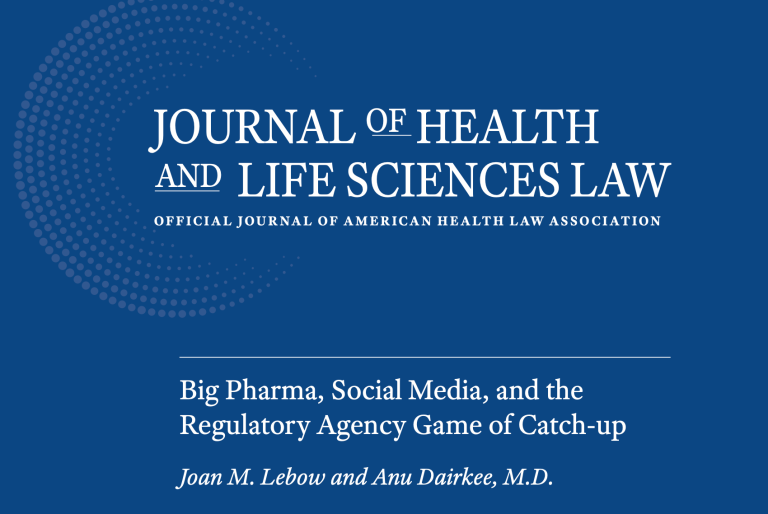
Partner Joan Lebow co-authored a timely article on pharmaceutical advertising and physician influencers in the social media era, published in the Journal of Health and Life Sciences Law. The article and accompanying podcast examine how FDA and FTC regulations are adapting to protect patients as drug companies find new ways to promote their products on social media.
Joan Lebow, Partner at EM³ Law, collaborated with Anu Dairkee, M.D. to author an article for the Journal of Health and Life Sciences Law, the official journal of the American Health Law Association (AHLA).
The article, titled ‘Big Pharma, Social Media, and the Regulatory Agency Game of Catch-up,’ sheds light on how social media affects patients’ medical choices within the framework of pharmaceutical promotion regulations.
The article explores how pharmaceutical manufacturers can effectively fulfill their mission to safely inform consumers, considering both the technical constraints of social media and the prevailing standard of health literacy in our country.
Legal issues addressed in the article encompass a range of concerns, from ensuring that newly crafted laws do not infringe upon First Amendment rights, to safeguarding vulnerable consumers susceptible to the influence of “experts” advocating for specific products to treat illnesses.
The article focuses on physician experts who may have financial interests or affiliations with pharmaceutical companies that leverage their status on social media. Physician influencers may boost sales of particular products and the FDA is conducting research on exactly this question. Assuming so, sociopolitical questions concern the value of increased sales in light of disclosure requirements applicable to the industry and ethical constraints on the physician who is paid to act as an influencer.
Over and under these considerations is the critical question of how the pharmaceutical industry can and should use social media to inform the public about drug risks and benefits in a way that is comprehensible to the consumer.
The article’s primary focus lies on FTC and FDA regulatory regimes that impact physician influencers and the pharmaceutical companies that hire them, the potential consequences of their endorsements and their role in the broader physician-patient dynamic as it exists on numerous social media platforms.
Additionally, they featured this article in a podcast where the authors discuss topics such as direct-to-consumer (DTC) advertising, the significance of health literacy in pharmaceutical advertising aimed at patients, the inequalities stemming from reduced health literacy, the pharmaceutical industry’s utilization of social media to expand DTC advertising, and the current state of regulations.
Tune in to the informative podcast
Joan M. Lebow
EM³’s Joan M. Lebow is a healthcare and commercial transactions lawyer. Her combination of corporate and private firm experience enables her to support clients as they face the challenges of regulatory compliance and risk management in their transactions and clinical delivery systems.
Published September 26, 2023. The law may have changed since. This publication is intended for general education and informational purposes only, and should not be regarded as either legal advice or a legal opinion. You should not act upon or use this publication or any of its contents for any specific situation. Recipients are cautioned to obtain legal advice from their legal counsel with respect to any decision or course of action contemplated in a specific situation. Maxson Mago & Macaulay, LLP and its attorneys provide legal advice only after establishing an attorney-client relationship through a written attorney-client engagement agreement. This publication does not establish an attorney-client relationship with any recipient.